Through the Smoke

Seeing Systems, Finding Home

Page 2 of 7

Resilience is Like the Flu – It is Contagious!

If you are involved in helping others with stress and trauma, you surely have been taught about “vicarious” or “secondary” trauma. Our brains are wired for empathy, so we feel what others are feeling. People who work with traumatized people begin exhibiting signs and symptoms of traumatic injury themselves. We warn of the risks of compassion fatigue and burnout. However, we rarely acknowledge that resilience is also contagious. Vicarious resilience is as real as vicarious trauma. “Compassion satisfaction” is as real is compassion fatigue.

When we help others who are injured, we become witnesses to their pain and their healing. The more empathetic we are, the more we are motivated and able to help, but that same quality leads us to take on more of others’ emotions. If we focus only on the pain, witnessing can be toxic as that pain takes root within us. If we also see and take in their healing, witnessing can bring that healing and growth within us. Most of us who actively seek to assist others in crisis have been there in one way or another – our own suffering and healing are often a large part of our motivation to serve others. Suffering gives rise to altruism as life takes on more meaning.

Vicarious resilience has been studied mostly in clinicians who work with highly traumatized people (e.g., survivors of torture), but the principles apply to those who are helping as friends or peers. All of us can benefit from remembering – and reminding each other – that being present to othersLove is contagious. When I share love, it comes back to me multiplied. - Louise Hay during tough times is not just a burden we carry out of duty. Even though we can and do hurt for others, we also heal and grow. As painful as some of the stories are, our lives can be enriched by witnessing the healing and growth of those we support. We can be transformed by our friends’ and coworkers’ resiliency, by finding new meaning in life, growing and developing ourselves, as well as knowing that we are of real value to them. Seeing other people bounce back and even grow after trauma can give all of us hope and guidance in coping with our own challenges.

Measuring Vicarious Resilience

The idea of vicarious resilience led to a tool for psychologists to measure it – the Vicarious Resilience Scale. It identifies seven factors:

  • Changes in life goals and perspective;
  • Hope inspired by those being helped;
  • Increased recognition of spirituality as a resource;
  • Increased capacity for resourcefulness;
  • Increased self-awareness and self-care practices;
  • Increased consciousness about power and privilege;
  • Increased capacity for remaining present while listening to painful stories.

In short, paying attention to the positives for others and ourselves when helping can make us better people and to become even more effective at helping others. Seeing yourself through the eyes of the person you are aiding is an effective way to nurture your own resilience.

Embracing the idea of vicarious resilience is yet another way to let go of the toxic myth that stress is harmful and burdensome. Stress only harms us when we fear it.


A resilience framework – connecting up, down and around

All of us are surrounded by sources of strength, resistance and resilience.  The better connected we are, socially, physically and spiritually, the more stress and challenges we can handle.

You’ll see this theme repeated in my classes and writing. For example, last month, I mentioned “Look up, look down, look around,” which is a wildland firefighting safety lesson about watching out for danger, which inspired this way of looking at resilience. In my pocket guide, Stress Management and Crisis Intervention, the theme of connecting in three dimensions repeats – out, in and up; mind, body, spirit; attitudes, activities and values.

Look around and you see social support, which psychologists repeatedly find has the strongest correlation to our resilience under stress and after trauma. Our co-workers, friends, family, mentors and other supportive people are our first line of strength when challenged or psychologically injured.

Look down and you see your body and the earth – your physical presence in creation. Through activities like yoga, exercise, sports, singing and dancing, we build and maintain connections to ourselves and the physical world. Our minds and bodies are inseparably linked when it comes stress. For example, science has found that a physical measurement, heart rate variability (HRV), correlates to both psychological and physical resilience. HRV is amazing in one respect – it doesn’t just measure your resilience, you can actually improve your ability to handle stress through biofeedback that increases your HRV. If that doesn’t convince you of how intimately our minds and bodies are linked, nothing will.

Look up and be reminded that the universe is vaster than we can comprehend, that as much as we can and should try to dissect and understand it, awe and mystery transcend logic and rationality. Spirituality in this context has to do with values and meaning, which often comes from religious beliefs.

(I included links to the Mayo Clinic web site because unlike so many stress management books and articles, they offer advice that embraces all three dimensions. Their books on stress and resilience are among the few that I recommend.)

When you are connected to these sources of strength and resilience, you know them – and they know you – with your body, heart and spirit. This is a kind of knowing that is beyond familiarity, information or even wisdom. It is a knowing that only arises from living in true relationships. It is knowing the way you know your spouse, your work, your community, your beliefs. This is the knowing that you can never completely put into words.

Looking at resilience as the result of our connections is simple and powerful. It explains our hunger for social media, as well as why it doesn’t truly satisfy (the connections are shallow and often deceptive). It shows why one-dimensional “stress management,” which usually focuses only on the physical, rarely succeeds. It helps us know where to focus when our resilience is low.

The biggest obstacle to connecting is distrust, especially when that distrust was learned at a young age. We all learn, to some extent, that we cannot trust other people, the universe or the divine, so we disconnect and become wary. If we have been deeply betrayed, some of these connections can seem threatening, even terrifying.

Distrust keeps us stuck in the “Ds” – discipline, domination, deception, drama, delay, docility, demandingness, or defiance. We are stuck socially when we don’t have people we can be real with. We are physically stuck when our health prevents us from exercising or experiencing nature. When forgiveness seems out of reach, for ourselves or others, we are spiritually stuck.

When we see and choose how to restore and nurture our weakest connections – which can be very difficult – we move from the “Ds” into the “As” – accepting, accompanying, attending, allowing, authenticity, affection, and agreement. The essence of resilience is how well we build and maintain the attitudes, activities and values that feed these qualities.

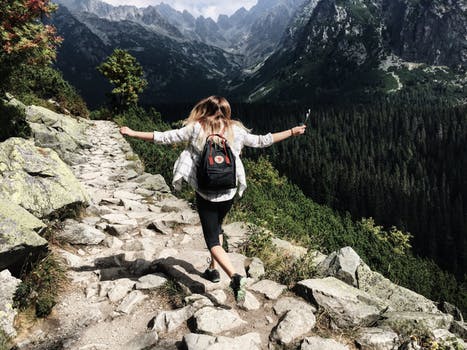
What Hiking Does To The Brain Is Pretty Amazing

Michael W. Pirrone reports on Wimp.com about new studies of the effects of hiking on the brain.

Excerpt: “According to a study published last July in Proceedings of the National Academy of Sciences, a 90-minute walk through a natural environment had a huge positive impact on participants.”

The article reports that hiking in nature lowers brooding and obsessive worry, increases creativity, helps you focus, gives you energy and strong self-image.

Trauma Dogs

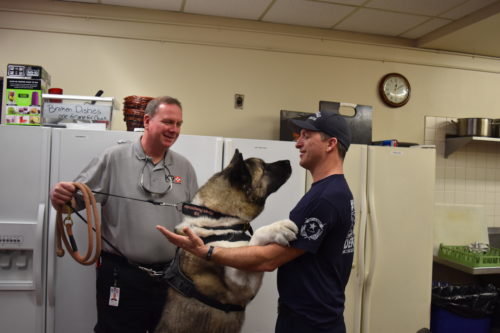
K9 First Responders Brad Cole and Spartacus (showing off) at LV Fire & Rescue.

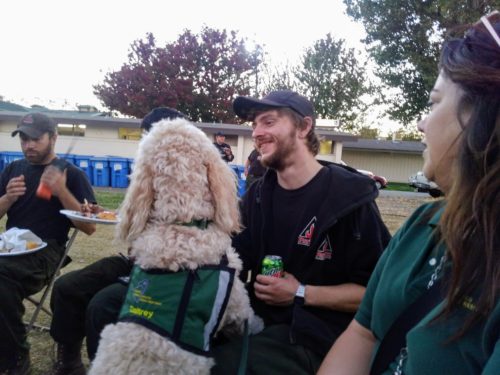
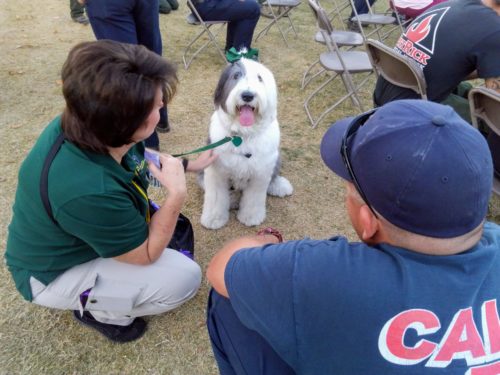
If you follow me, you know that I’ve been looking at the role of dogs in critical incident and trauma responses. A couple of years ago, while working for CAL FIRE at the big Lake County fires, I noticed, as did the rest of the peer support team, that dogs are excellent

icebreakers. The fact is that few firefighters will stop and talk to peer support ordinarily – but that changes when dogs are involved. Nobody judges when you play with a dog.


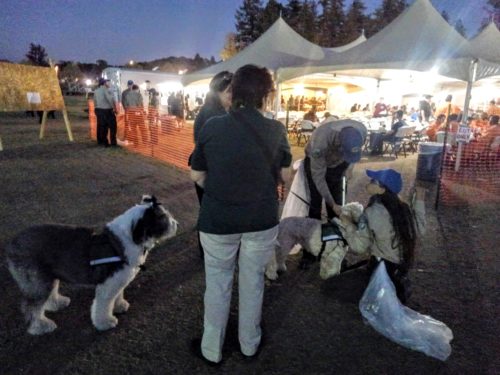
As I wrote last month, we invited many dog teams (a team is a dog and handler) to Santa Rosa during the North Bay fires in October. They certainly proved their worth. We could see people relax and open up while petting or playing with the K9s. A couple of weeks ago, one of the line supervisors, Bill B., told me how he had been doing paperwork in camp, exhausted and cranky, when he saw a dog team approaching. Go away, he thought. I’m too busy. But the team – Michael Jacobs and Molly from Hope AACR – came over to him.

Sharon Martin and Abby from Hope AACR

A minute or later, Bill said, he was relaxed and grateful that they stopped by. That’s the kind of story we want to hear!

Last Thursday, I spent the day visiting Las Vegas Fire and Rescue stations with Brad Cole, the founder of Connecticut-based K9 First Responders (KFR), and his trauma dog, Spartacus. Brad and Spartacus, along with other KFR teams, were deployed to the October 1st mass shootings. KFR has also responded to Newtown for the Sandy Hook shootings and many other crises.

We can learn a lot from dogs about crisis response. They are quite sensitive to our emotions. Recent research demonstrates how well they can read us. Many dogs instinctively go to a person in distress – Brad, others and I have seen this happen many times. It happens in my home, too – when I get frustrated, usually by a computer – Kairo, our Maltese, often comes running to me.

Our dogs, Kasha (Bichon) and Kairo (a very big Maltese)

In other words, the first thing we teach in crisis intervention – to acknowledge emotions – comes naturally to dogs. Equally important, they don’t do things many of us, especially in public safety, have a hard time resisting – they don’t give advice, try to “fix” the person or make it better. They are simply present. The fact that they can’t do anything makes dogs non-threatening; safe to be with.

Dogs don’t understand what happened, but they don’t need to. They just know when we are hurting. They show us that it isn’t necessary to understand what happened. Perhaps responders can tell family and friends that the best way to support them is to act like a dog – just be present.

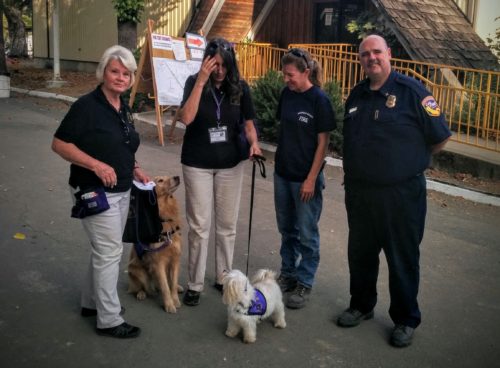
PALS (Paws As Loving Support) dogs at the Valley Fire, Lake County 2015.

The helpfulness of animals for emotionally distressed people is being researched – primarily horses and dogs, but also dolphins and even cats, despite their aloofness. Eye contact and touch play big roles in helping our nervous systems calm down. Dogs and horses are sensitive to danger, so when they are calm, we know we are safe.

A 2015 literature review of research on animal-assisted intervention concluded that although research is still in early stages, “All reported positive outcomes” for traumatized people. Studies showed reduced depression and reduced PTSD symptoms.

Here in the San Francisco Bay Area, after seeing how effective dogs are, we are increasing our collaboration and integration of K9 teams in crisis response.


Where Are You? Reflections on California Fires

(Message delivered at New Creation Lutheran Church, Sunday, December 17, 2017)

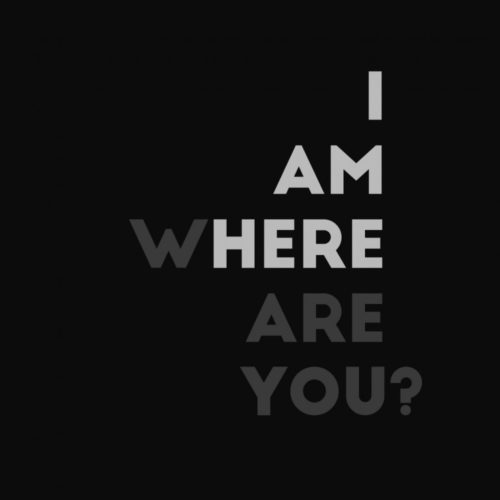
“Where are you?” That’s the first thing God says to a human being in the Bible.

Then the man and his wife heard the sound of the Lord God as he was walking in the garden in the cool of the day, and they hid from the Lord God among the trees of the garden. But the Lord God called to the man, “Where are you?”

He answered, “I heard you in the garden, and I was afraid because I was naked, so I hid.” (Genesis 3:8-10)

Throughout the Bible, God asks people questions, but I think we can be sure it is never because God is hungry for information – God knows the answers. We need to be asked.

We call this story in Genesis the “fall from grace” or “original sin.” We talk about it as our disconnection from God – that’s what the word “sin” means.  But as I have studied faith, psychology and neurophysiology for crisis intervention, peer support and chaplaincy, I have come to see that we need three dimensions of connection. All three become broken in the Genesis story.

The first disconnection is social. Adam, Eve and the serpent, rather than supporting each other, talk each other into doing the wrong thing.

The second is physical. Childbirth and food production will be painful; Adam and Eve will “return to dust,” becoming part of the earth that they were taken from.

The third disconnection is spiritual – they are banished from the garden and no longer have access to the tree with knowledge of good and evil, the tree of life. They no longer walk with God in the garden.

God’s question, “Where are you?” is about relationships. Where are you socially – your relationships, knowing your friends and neighbors? Where are you physically, in relationship with creation, knowing yourself, your body and the earth. Where are you spiritually, in relationship with the divine, knowing what is right and wrong?

I teach this by inviting people to think of them as directions. In wildland firefighting, one of our safety mottos is “Look up, look down, look around” – keep your head on a swivel so you will be aware of all of the things that can hurt or kill you in that dangerous environment.

Look around and you see your social support, which psychologists repeatedly find has the strongest correlation to our resilience under stress and after trauma.

Look down and you see your body and the earth – your physical presence in creation.

Look up and be reminded that the universe is far more than we can comprehend, that as much as we can and should try to dissect and understand it, awe and mystery transcend logic and rationality.

Jesus points to these dimensions when he answers the question “Which is the greatest commandment in the law?” He replies: “Love the Lord your God with all your heart and with all your soul and with all your mind… And the second is like it, ‘Love your neighbor as yourself.” (Matthew 22:36-40). Your neighbor, yourself and God – social, physical, spiritual. How are your connections to them?

Although my primary work with CAL FIRE and others is called “critical incident stress management” or “peer support,” it is really about disconnection and connection.

When God asked Adam “Where are you?” Adam said he was afraid, so he hid. Fear leads us to disconnect from others, the physical world and God.

Fear is powerful. One of the most surprising recent discoveries about stress showed that it is only toxic to your health if you are afraid that it is. A big study about stress over 10 years found that people who had the highest stress level, but did not believe that stress is bad for your health, were least likely to die. (In a wonderful “coincidence,” the church’s theme on the day I offered this message turned out to be 1 John 4:16 – “Perfect love casts out fear.”)
I have never found anything in the Bible that suggests that when life becomes challenging, the answer is be “stress reduction,” which research shows rarely works anyway. The Biblical response to stressful situations is repeated hundreds of times – “Don’t be afraid.” The words that usually follow are, “I am with you.” Relaxation is not the opposite of distress; connection is. Even when Jesus retreated to the wilderness, it was not to disconnect, but to re-connect. Solitude is not the same as isolation.

Whether I respond to a fire as a chaplain or with CAL FIRE’s employee support team, our job is to be present for people to talk to and connect with. Most of it is quite informal, after things really go out of control, we also lead formal crisis interventions. We primarily serve the firefighters, but we have always also been available to other responders and the public. We ask a lot of questions, even though we often know, in a general sense, what the answers will be. In fact, after 15 days on the fires in the North Bay, I felt as though I had heard the same two stories – the citizen story and the responder story – hundreds of times.

For the citizens, it was a story of being woken in the dead of night, wondering if they would escape from a terrifyingly fast-moving fire. The story included many heroes – people who risked their lives to wake up their neighbors and help do things like figure out how to open a garage door when there was no power.

For the responders, the story was about staying awake for more than four days until there was finally enough help that they could take a day off. They talked about embers the size of basketballs blowing a mile or more ahead of the fire; falling asleep holding a nozzle or dozing for a few minutes in their engines only to be woken by someone pounding on their windows and yelling for them to get out because the fire was nearly on top of them. They described situations where it was their job to rescue people they could not reach, and wondering over and over if they would survive themselves.

One thing we never ask is, “How are you doing?” The answer is almost always, “Fine.” To our team, FINE stands for Frustrated, Insecure, Neurotic and Emotional. We don’t let each other get away with that answer, either.

Whether I was talking to citizens or firefighters, all it took for the stories to start pouring out was to say something like, “I know I can’t possibly understand how this is for you, but it’s got to be very hard.”

In this kind of situation, as people talk about what happened to them, we mostly listen, acknowledging and normalizing their reactions. We offer some education and resources to help them get through the crisis. In Santa Rosa, we also had the privilege of handing out $100 gift cards that the firefighters union provided.

Some of the tougher moments came as people talked about their neighborhoods and friendships, realizing that they had not just lost their homes, but entire communities. Along with the physical losses, that is an enormous loss of social connections.

For many of the firefighters, one of the hardest parts was hearing all of the thank-you’s from the community. Like all public safety people, we are perfectionists – the minimum passing score on our job is 100 percent. So it is very difficult to have a person who is sifting through the ashes of their home say “Thank you.” For me, it was most difficult of all when that person was a firefighter. After doing this kind of thing for more than a dozen years, I’m rarely at a loss for words. But for the firefighters who lost their own homes, I had nothing but big hugs. And that’s okay.

For a few days, there was a crowd of a couple of hundred people just outside of the fairgrounds where the base camp was located. They had signs and noisemakers and they would cheer loudly when we drove by, heading out to the fire. I was so overwhelmed that I couldn’t even look at them to thank them or say, “You’re welcome.” More than 8,000 homes were lost in the North Bay. Forty-two people were killed. I had to remind myself, just as I urged other responders, to remember that so many homes and lives were also saved.

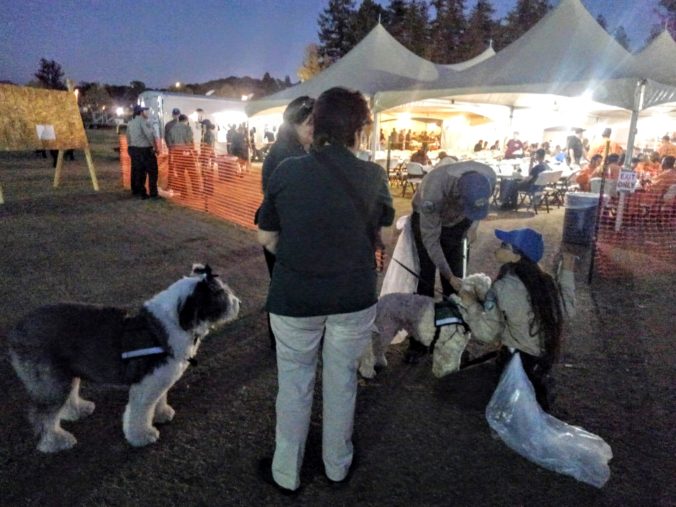
In our peer support response, we did something new – we called in every dog team we knew about. At earlier fires, especially in Lake County two years earlier, we’d seen how effective dogs can be.

We saw firefighters, EMTs and dispatchers relax and open up as they petted and played with the dogs. I had a CAL FIRE captain as an instructor a couple of weeks ago. He told me that he was exhausted and irritable, doing paperwork, when one of our dog teams approached him. “Go away, I don’t have time for this,” he thought. Two minutes later, after petting the dog, he said he was relaxed and grateful that they were there. That’s what we want to hear.

If there’s a Biblical model for crisis intervention, it is the story of the disciples on the road to Emmaus. They are in deep grief because their friend and teacher, who they thought would become their king and savior has been crucified. They don’t believe the stories of the women who claim to have seen him.

Jesus could have appeared to them as himself and cleared everything up immediately. But instead, he appears as a stranger who doesn’t know what’s been going on. “Are you the only visitor to Jerusalem who doesn’t know the things that have happened there in the last few days?” one asks (Luke 24:18). Like God in the Garden of Eden, he asks a question  – “What things?” – even though he already knows the answer. He doesn’t need information; they need to tell their story. Like in the Garden, the story falls short of the full truth – they have the facts right, but the bigger perspective is missing, so he reminds them of the Biblical prophecies of death and resurrection. They don’t finally recognize him until he joins them for dinner and breaks the bread – the symbol of his sacrifice.

The question, “Where are you?” seemed especially meaningful in the aftermath of these fires because I think that we tend to discount the importance of our connections to the physical world – our own bodies and the earth. We don’t eat well, we don’t exercise enough and we have greatly isolated ourselves from nature. And because we don’t appreciate nature deeply, we have been building homes in places that are highly vulnerable to this kind of disaster.

So I invite you to tackle God’s first question – where are you? We need to answer it often. Where are you in your relationships with neighbors, yourselves and God?

 

15 Days (with dogs) on the North Bay fires

I’m still decompressing from the North Bay fires, but here are some thoughts on the experience.

  • I’m grateful for CAL FIRE’s trust. It is a privilege to work with its Employee Support Services team and CISM leads. They are devoted, compassionate, hard-working people, without exception.
  • If there was a big story coming out of our deployment, it was the dogs. Two years ago, chaplains brought their personal PTSD service dogs to the Rocky and Valley fires (also in the North Bay). We saw what a great comfort and ice-breaker they can be. So this time, we invited just about every trained service, therapy or comfort dog we knew about. The result
    Hope AACR dogs outside breakfast in fire camp.

    Hope AACR dogs outside breakfast in fire camp.

    was that we had dogs present in base camp (which peaked at about 6,000 people) every day. We even took the most highly trained dogs, from Hope AACR, whose handlers were former first responders, out to public safety agencies and neighborhoods that burned. We also had a great response from PALS and others whose names I don’t have. The dogs helped people relax and sometimes seemed to be the key to lowering anxiety about telling their painful stories. As a result, all of us are thinking about how to integrate dogs – and their handlers, of course – into our responses (large or small).

  • Hearing “thank you” from people who lost their homes and entire neighborhoods, was often difficult. For a few days, a crowd of up to 200 people with signs and
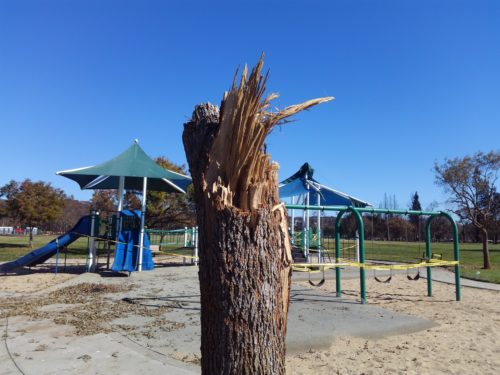
    Tree snapped off in Coffey Park.

    Coffey Park – tree snapped off.

    noisemakers stood on the corner by the fire camp at the county fairgrounds, cheering and waving at every fire vehicle that came or left. It was so overwhelming sometimes that I could not even look at them. I think the gratitude is hard because people in public safety tend to be perfectionists – it makes us good at the work – so we focus on what we did not accomplish.  I found myself repeatedly urging firefighters, EMTs and others to “let it be both” – sadness at the tremendous losses, but pride in what was accomplished. My most difficult thank-you came from a little girl in Coffey Park, perhaps six years old. I gave her a CAL FIRE badge sticker and she looked me in the eye, saying, “Thank you for saving our houses and lives.” I had to turn around, take about 15 steps breathing deeply, before I could turn back, smile and say, “You’re welcome.” I really just wanted to go somewhere and cry. They deserve our tears.

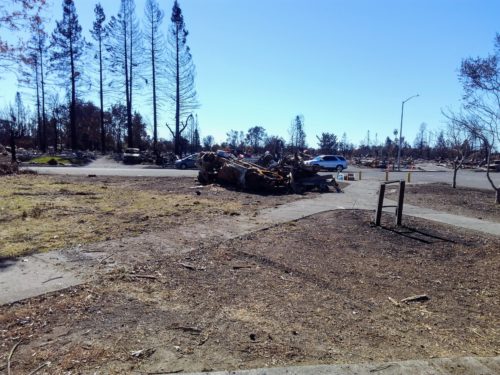
    Coffey Park – note aluminum from a structure caught high in tree.

  • I communicated back and forth with Angela Leath, who heads peer support for the Las Vegas Fire Department. She is dealing with the aftermath of their horrendous shooting incident, so we traded ideas – what’s working, what’s not – about responding to a large incident. Our conversation helped me remember that we can expect many people too struggle with feelings of guilt – that they didn’t do enough, that they made wrong decisions, that they were not there. We know we can’t save every house and every life, but part of us – a good part – will always whisper that we should have.
  • Exercise really helps, even when you are worn out. Eight or nine days into our deployment, I decided that the best thing I could do for myself would be the kind of hiking I ordinarily do every two or three days – three miles, with at least 25 lbs in my pack, at a fast pace (this keeps me in shape for firefighting and has done wonders for my health). Afterwards, I felt almost normal again. It was as if I’d punched a “reset” button in my body and brain.
  • It was an incredible privilege to help distribute cash gift cards from the California Professional Firefighters’ foundation. We could give them to anyone who lost at least 25 percent of their home. Although a  few people accepted them matter-of-factly, most seemed stunned when I explained what was in the envelope. Many big hugs resulted. Thousands of them have been given to fire victims in the North Bay.
  • It seemed as though nearly everybody wanted to tell us their stories. That’s unprecedented, in my experience. Almost everybody – firefighters on the line, doing damage inspection, mopping up, in overhead management – stopped for a while to talk about how they were doing (especially when we had dogs!). That speaks both to the magnitude of the fires and the changing public safety culture. It is becoming okay to acknowledge how difficult this work can be.
  • After doing and teaching this kind of work – crisis intervention and peer support – for more than a dozen years, I usually have some kind and gentle words for any situation. But three times in Coffey Park, I met firefighters who lost their own or family homes. For them, I had no words, just a lot of eye contact and big hugs. And that’s okay – if there is any time no words are needed, that’s it.
  • We will be talking about, and healing from these fires for a long time. Until last month, the “career fire” for most people was the Valley fire in 2015. More than once, our team and others mentioned that we are still dealing with it. This year’s fires killed many more people and destroyed more than three times as many homes. And more than once, I heard someone ask the rhetorical – and scary – question, “Is this the new normal?”
  • Something to be grateful for – because the fire happened at night, when people are home, most of their pets survived. That’s really good.

Peer support act is dead (for now) in California Senate

AB 1116, which would have created privilege (legal confidentiality) for CISM and peer support, is dead for this session of the California legislature. However, it is expected to come back in the 2018 session.

Although the bill passed the Assembly and several Senate committees, no agreement had been reached on how to define the training standards required for CISM or peer support team members to be protected. The current version specifies that the state Office of Emergency Services (OES) would create a new class – and nobody in state emergency services (apparently including OES) thought that was a good idea. But there was not enough time in this legislative session to work out the definition, so the bill went to the inactive file.

Hopefully the relevant state agencies (corrections, CHP, CAL FIRE, OES) will work out a training requirements strategy before the bill comes around again, so that it can pass next year.

Passed CA Assembly – Peer Support and Crisis Referral Services Act

California Assembly Bill 1116, formerly called the Critical incident Stress Management Services Act, has passed the state assembly and is on its way to the Senate. If it becomes law, the act would protect the confidentiality of public safety peer support team interactions except in the case of criminal proceedings. To be covered, team members would have to have completed a peer support training course to be developed by the Office of Emergency Services, the California Firefighter Joint Apprenticeship Committee or the Commission on Correctional Peace Officer Standards and Training.

This legislation would not give the level of protection that a therapist or ordained clergy has, but it will raise the bar considerably – unlike states that have passed similar laws, peer support and CISM teams in California currently have no protection against being subpoenaed. However, in the context of non-criminal proceedings, the legal “privilege” would be the same as between a psychotherapist and patient. The only exception would be “gross negligence or intentional misconduct.”

All of the components of a CISM program along with grief support and substance abuse are named as topics the law would cover.

The bill includes the phrase “toxic stress,” which I believe we should strike from our vocabulary. Stress can be toxic, but it doesn’t have to be, and the phrase “toxic stress” carries a strong connotation that all stress is toxic. That can be a self-fulfilling expectation – if you think stress is toxic, it probably will be.

This is a great step forward for California. I would have preferred that the state also recognize ICISF-approved training, rather than only requiring new courses, but “peer support” covers more than ICISF encompasses, so it is understandable.

If you’re in California, urge your senator to vote in favor. Let’s get the law in place, develop the classes and take the training.

From Quora: Is there a way to make yourself immune to PTSD?

I wrote the following in response to a question on Quora.

Although all of the reasons PTSD develops are not understood, the first thing to keep in mind is that it is a spectrum. For many people it is usually mild and manageable, although it can become quite uncomfortable (or just tiresome) when it is triggered. Realize that hundreds of thousands of public safety workers, who don’t fit any of your categories, live and work with PTSD. Many go though most of their days without giving it a thought.

One of the strong correlations to PTSD risk is how much REM sleep you get. A person who isn’t getting good REM sleep, due to sleep apnea, alcohol or drug use, or anything else that prevents them from dropping into that deeper sleep, is at higher risk. The theory is that our brains consolidate memories during REM sleep, so that we we essentially forget the emotions along with the event. (PTSD is sort of like “remembering” – or re-living – the emotions separately from the event.) There is a good argument that energy drinks and other substances that improve memory also can increase your risk, simply because they improve your memories of the bad event.

It is a mistake to decide if you “should” have a post-traumatic stress injury, based on what happened. “Should” is a word to get rid of in this context. What matters is how you reacted. I meet with people who witnessed or experienced terrible things, but they don’t have a strong reaction – they didn’t feel particularly helpless or out of control. They may not need any intervention at all, even though the incident would have been traumatic for many other people. But the converse is true – a person can experience extreme feelings of helplessness and out-of-control from a seemingly “minor” event and have a significant post-traumatic stress injury. Although those events usually involve loss of life or the threat of it, serious injury, etc. , the common factor is the reaction, not what happened.

There is absolutely nothing in the news article that would indicate whether or not someone involved might be at risk for PTSD. Again, the facts of what happened are not very important; your perception of what happened, along with physiological factors and what else you may have experienced previously (prior trauma can set you up for a more serious injury) all contribute.

I often invite people in your position to say this to themselves: “My stress is the worst stress because it is MY stress.” Comparing yourself to others – especially based only on the facts – is always a mistake (“No comparison stress shopping.”)

Be gentle with yourself. Be as gentle with yourself as you would be with a friend who had the same reactions.

I doubt there is any guaranteed way to become immune to PTSD, but if you aren’t getting good REM sleep and can make changes to do so, that almost certainly will help. Social support has also been shown to correlate to reducing the impact of traumatic events. Connecting with your body and nature – things like meditation, yoga, hiking – also help to activate the part of your nervous system that tells your “fight or flight” response that it is safe to de-activate. Spirituality, in the sense of having bigger-than-self values, also seems to help.

Stress doesn’t have to be toxic. Kelly McGonigal (“The Upside of Stress”) gives a good summary of this in her TED Talk. Watch to the very end, where she gives a great bit of advice: “Chasing meaning is better for your health than trying to avoid discomfort.”

CISM Protection Bill Introduced in California

California may join Michigan and other states that have made CISM activities “privileged” communications, meaning they could not be subpoenaed or otherwise demanded by a court. Michigan’s legislature unanimously passed the “First Responder Privileged Communications Act” a year ago.Subpoena protection for California CISM

California will consider AB 1116, the Critical Incident Stress Management Services Act.

Here is the key provision.

Except as otherwise provided in this section, a communication made by an emergency service provider to a CISM team member while the emergency service provider receives CISM services is confidential and shall not be disclosed in a civil, criminal, or administrative proceeding. A record kept by a CISM team member relating to the provision of CISM services to an emergency service provider by the CISM team or a CISM team member is confidential and is not subject to subpoena, discovery, or introduction into evidence in a civil, criminal, or administrative proceeding.

The exceptions are not problematic – they cover referrals, events where most of us are already mandated reporters, imminent threats and waivers.

The bill was introduced last month by Assemblyman Tim Grayson, former mayor of Concord, California, who is also a Concord Police Department “Critical Response Chaplain.” He undoubtedly knows a thing or two about this issue.

In my dozen years in CISM I’ve dealt with this through our team’s policy of never keeping written records and my own lousy memory for what other people say during interventions.

« Older posts Newer posts »

© 2026 Through the Smoke

Theme by Anders NorenUp ↑