Seeing Systems, Finding Home

Month: January 2018

Resilience is Like the Flu – It is Contagious!

If you are involved in helping others with stress and trauma, you surely have been taught about “vicarious” or “secondary” trauma. Our brains are wired for empathy, so we feel what others are feeling. People who work with traumatized people begin exhibiting signs and symptoms of traumatic injury themselves. We warn of the risks of compassion fatigue and burnout. However, we rarely acknowledge that resilience is also contagious. Vicarious resilience is as real as vicarious trauma. “Compassion satisfaction” is as real is compassion fatigue.

When we help others who are injured, we become witnesses to their pain and their healing. The more empathetic we are, the more we are motivated and able to help, but that same quality leads us to take on more of others’ emotions. If we focus only on the pain, witnessing can be toxic as that pain takes root within us. If we also see and take in their healing, witnessing can bring that healing and growth within us. Most of us who actively seek to assist others in crisis have been there in one way or another – our own suffering and healing are often a large part of our motivation to serve others. Suffering gives rise to altruism as life takes on more meaning.

Vicarious resilience has been studied mostly in clinicians who work with highly traumatized people (e.g., survivors of torture), but the principles apply to those who are helping as friends or peers. All of us can benefit from remembering – and reminding each other – that being present to othersLove is contagious. When I share love, it comes back to me multiplied. - Louise Hay during tough times is not just a burden we carry out of duty. Even though we can and do hurt for others, we also heal and grow. As painful as some of the stories are, our lives can be enriched by witnessing the healing and growth of those we support. We can be transformed by our friends’ and coworkers’ resiliency, by finding new meaning in life, growing and developing ourselves, as well as knowing that we are of real value to them. Seeing other people bounce back and even grow after trauma can give all of us hope and guidance in coping with our own challenges.
Measuring Vicarious Resilience

The idea of vicarious resilience led to a tool for psychologists to measure it – the Vicarious Resilience Scale. It identifies seven factors:

  • Changes in life goals and perspective;
  • Hope inspired by those being helped;
  • Increased recognition of spirituality as a resource;
  • Increased capacity for resourcefulness;
  • Increased self-awareness and self-care practices;
  • Increased consciousness about power and privilege;
  • Increased capacity for remaining present while listening to painful stories.

In short, paying attention to the positives for others and ourselves when helping can make us better people and to become even more effective at helping others. Seeing yourself through the eyes of the person you are aiding is an effective way to nurture your own resilience.

Embracing the idea of vicarious resilience is yet another way to let go of the toxic myth that stress is harmful and burdensome. Stress only harms us when we fear it.
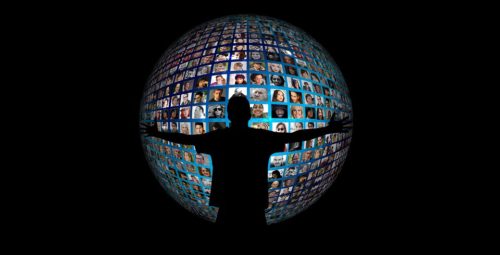


A resilience framework – connecting up, down and around

All of us are surrounded by sources of strength, resistance and resilience.  The better connected we are, socially, physically and spiritually, the more stress and challenges we can handle.

You’ll see this theme repeated in my classes and writing. For example, last month, I mentioned “Look up, look down, look around,” which is a wildland firefighting safety lesson about watching out for danger, which inspired this way of looking at resilience. In my pocket guide, Stress Management and Crisis Intervention, the theme of connecting in three dimensions repeats – out, in and up; mind, body, spirit; attitudes, activities and values.

Look around and you see social support, which psychologists repeatedly find has the strongest correlation to our resilience under stress and after trauma. Our co-workers, friends, family, mentors and other supportive people are our first line of strength when challenged or psychologically injured.

Look down and you see your body and the earth – your physical presence in creation. Through activities like yoga, exercise, sports, singing and dancing, we build and maintain connections to ourselves and the physical world. Our minds and bodies are inseparably linked when it comes stress. For example, science has found that a physical measurement, heart rate variability (HRV), correlates to both psychological and physical resilience. HRV is amazing in one respect – it doesn’t just measure your resilience, you can actually improve your ability to handle stress through biofeedback that increases your HRV. If that doesn’t convince you of how intimately our minds and bodies are linked, nothing will.

Look up and be reminded that the universe is vaster than we can comprehend, that as much as we can and should try to dissect and understand it, awe and mystery transcend logic and rationality. Spirituality in this context has to do with values and meaning, which often comes from religious beliefs.

(I included links to the Mayo Clinic web site because unlike so many stress management books and articles, they offer advice that embraces all three dimensions. Their books on stress and resilience are among the few that I recommend.)

When you are connected to these sources of strength and resilience, you know them – and they know you – with your body, heart and spirit. This is a kind of knowing that is beyond familiarity, information or even wisdom. It is a knowing that only arises from living in true relationships. It is knowing the way you know your spouse, your work, your community, your beliefs. This is the knowing that you can never completely put into words.

Looking at resilience as the result of our connections is simple and powerful. It explains our hunger for social media, as well as why it doesn’t truly satisfy (the connections are shallow and often deceptive). It shows why one-dimensional “stress management,” which usually focuses only on the physical, rarely succeeds. It helps us know where to focus when our resilience is low.

The biggest obstacle to connecting is distrust, especially when that distrust was learned at a young age. We all learn, to some extent, that we cannot trust other people, the universe or the divine, so we disconnect and become wary. If we have been deeply betrayed, some of these connections can seem threatening, even terrifying.

Distrust keeps us stuck in the “Ds” – discipline, domination, deception, drama, delay, docility, demandingness, or defiance. We are stuck socially when we don’t have people we can be real with. We are physically stuck when our health prevents us from exercising or experiencing nature. When forgiveness seems out of reach, for ourselves or others, we are spiritually stuck.

When we see and choose how to restore and nurture our weakest connections – which can be very difficult – we move from the “Ds” into the “As” – accepting, accompanying, attending, allowing, authenticity, affection, and agreement. The essence of resilience is how well we build and maintain the attitudes, activities and values that feed these qualities.

What Hiking Does To The Brain Is Pretty Amazing

Michael W. Pirrone reports on Wimp.com about new studies of the effects of hiking on the brain.

Excerpt: “According to a study published last July in Proceedings of the National Academy of Sciences, a 90-minute walk through a natural environment had a huge positive impact on participants.”

The article reports that hiking in nature lowers brooding and obsessive worry, increases creativity, helps you focus, gives you energy and strong self-image.

Trauma Dogs

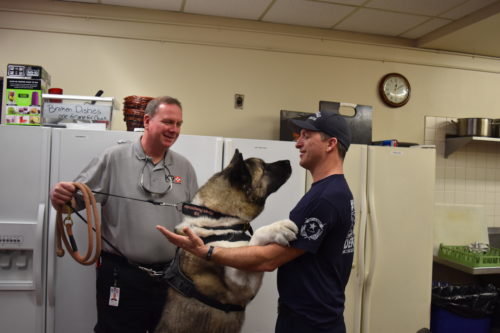
K9 First Responders Brad Cole and Spartacus (showing off) at LV Fire & Rescue.

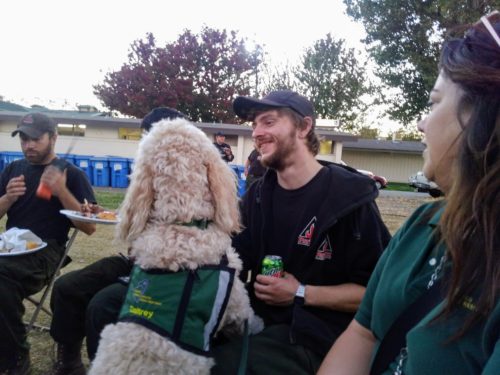
If you follow me, you know that I’ve been looking at the role of dogs in critical incident and trauma responses. A couple of years ago, while working for CAL FIRE at the big Lake County fires, I noticed, as did the rest of the peer support team, that dogs are excellent

icebreakers. The fact is that few firefighters will stop and talk to peer support ordinarily – but that changes when dogs are involved. Nobody judges when you play with a dog.


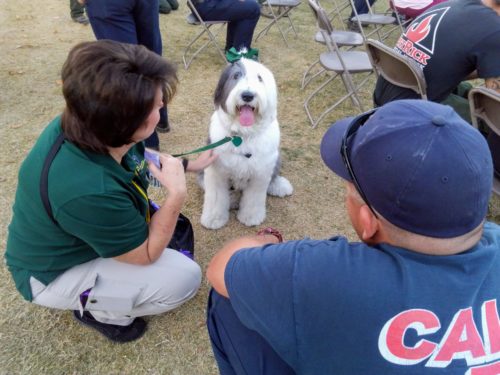
As I wrote last month, we invited many dog teams (a team is a dog and handler) to Santa Rosa during the North Bay fires in October. They certainly proved their worth. We could see people relax and open up while petting or playing with the K9s. A couple of weeks ago, one of the line supervisors, Bill B., told me how he had been doing paperwork in camp, exhausted and cranky, when he saw a dog team approaching. Go away, he thought. I’m too busy. But the team – Michael Jacobs and Molly from Hope AACR – came over to him.

Sharon Martin and Abby from Hope AACR

A minute or later, Bill said, he was relaxed and grateful that they stopped by. That’s the kind of story we want to hear!

Last Thursday, I spent the day visiting Las Vegas Fire and Rescue stations with Brad Cole, the founder of Connecticut-based K9 First Responders (KFR), and his trauma dog, Spartacus. Brad and Spartacus, along with other KFR teams, were deployed to the October 1st mass shootings. KFR has also responded to Newtown for the Sandy Hook shootings and many other crises.

We can learn a lot from dogs about crisis response. They are quite sensitive to our emotions. Recent research demonstrates how well they can read us. Many dogs instinctively go to a person in distress – Brad, others and I have seen this happen many times. It happens in my home, too – when I get frustrated, usually by a computer – Kairo, our Maltese, often comes running to me.

Our dogs, Kasha (Bichon) and Kairo (a very big Maltese)

In other words, the first thing we teach in crisis intervention – to acknowledge emotions – comes naturally to dogs. Equally important, they don’t do things many of us, especially in public safety, have a hard time resisting – they don’t give advice, try to “fix” the person or make it better. They are simply present. The fact that they can’t do anything makes dogs non-threatening; safe to be with.

Dogs don’t understand what happened, but they don’t need to. They just know when we are hurting. They show us that it isn’t necessary to understand what happened. Perhaps responders can tell family and friends that the best way to support them is to act like a dog – just be present.

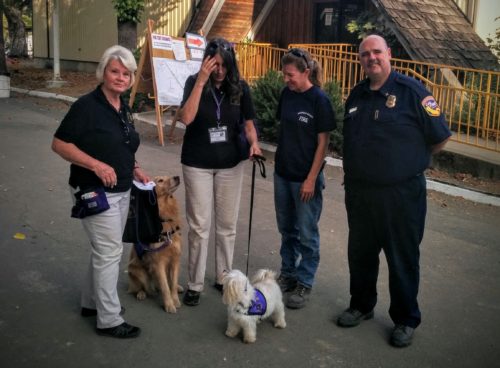
PALS (Paws As Loving Support) dogs at the Valley Fire, Lake County 2015.

The helpfulness of animals for emotionally distressed people is being researched – primarily horses and dogs, but also dolphins and even cats, despite their aloofness. Eye contact and touch play big roles in helping our nervous systems calm down. Dogs and horses are sensitive to danger, so when they are calm, we know we are safe.

A 2015 literature review of research on animal-assisted intervention concluded that although research is still in early stages, “All reported positive outcomes” for traumatized people. Studies showed reduced depression and reduced PTSD symptoms.

Here in the San Francisco Bay Area, after seeing how effective dogs are, we are increasing our collaboration and integration of K9 teams in crisis response.


© 2026 Through the Smoke

Theme by Anders NorenUp ↑